
We are excited to announce the launch of a new magazine section for Afar Bags, where we will share captivating travel stories inspired by culture and creativity. As the photographers from Ayzoh, we aim to bring these narratives to life through stunning visuals and insightful articles. Our inaugural piece delves into the rich cultural significance of coffee in Ethiopia.
At the center of this ritual sits a clay coffee pot. Many people call the pot jebena. Some also use the name jabana across the wider region. The form stays consistent. A wide base for stability and heat. A narrow neck to manage boiling and settling. A small spout for a controlled pour. A handle placed high, close to the neck, for safe handling near fire.
A pot made for heat
A jabana starts as a solution to practical needs. Clay holds heat and releases heat slowly. The wide belly keeps the pot steady on charcoal. The narrow neck supports a calm settle of coffee grounds before serving. The spout guides a thin stream into small cups. Many makers add a simple filter at the spout, often from local fibers, to keep grounds back during pouring.
The shape looks timeless because the shape works. Each curve supports a step of brewing, without extra parts, without metal, without complex tools.
Ensira Pottery Center, Addis Ababa
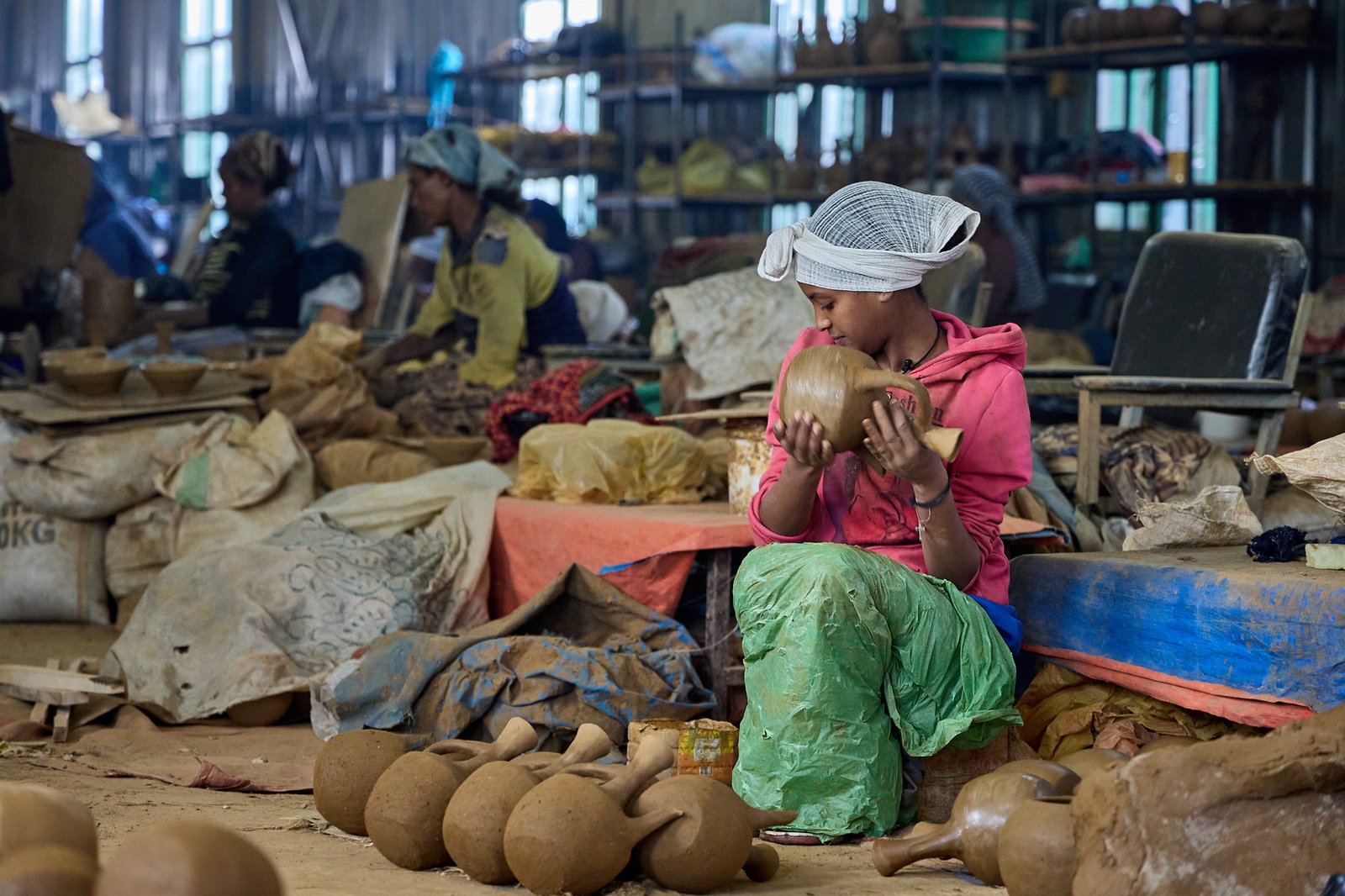
This article stays close to making. Ayzoh! photographers worked at Ensira Pottery Center in Addis Ababa, a women’s cooperative where makers produce household pottery, including coffee pots. The images follow the full chain, from raw clay to finished vessel. Hands lead every step. Time leads the rest.
Ensira also shows a shared way of working. Makers gather in one place. Work flows through shared spaces for mixing, shaping, drying, firing, and selling. A cooperative structure gives makers stronger control over quality, pricing, and visibility.


From earth to workable clay
Jabana making begins with material selection. Clay arrives with grit, stones, and plant fragments. Makers break dry chunks by hand. Makers remove impurities. Water turns dry clay into a workable mass.
Then comes wedging. Makers knead and fold the clay to even out moisture and remove trapped air. This step sets the tone for the whole pot. Poor preparation leads to cracks later, especially around the neck and the handle.
Forming the body
Many Ethiopian household vessels come from hand-building traditions. Makers build the round belly first, then draw the neck upward. Some makers use coils. Some use paddling and shaping against a support. The method matters less than the result. A smooth wall thickness. A balanced center of gravity. A neck strong enough to handle repeated heat cycles.
A jabana body needs precision. Thin walls heat fast but break more easily. Thick walls resist cracking but slow the brew. Makers solve this balance through experience, touch, and repetition.
Spout, neck, handle
The spout defines the pour. Makers shape the spout as a clean channel, then refine the lip so liquid leaves the pot in one stream, without drips. Makers align the spout with the handle so pouring feels natural and controlled.
The neck carries stress. Rapid temperature change concentrates strain in this area. Makers often compress clay around the neck to strengthen the surface. Many makers also smooth and burnish the neck to tighten pores and reduce micro-cracks.
The handle looks simple. The handle needs strength. Makers score and slip the joining points, then press and blend the connection so the handle becomes part of the body, not a piece placed on top.


Drying as a skill
Drying decides success. Makers slow-dry the pot to avoid warping and cracking. Airflow, sun, shade, and stacking all matter. A rushed dry creates hairline fractures, often invisible until firing.
At Ensira, drying becomes a shared discipline. Pots rest in groups. Makers watch each other’s pieces. Makers adjust placement through the day, moving pots as light and temperature change.
Firing and finish
Firing locks the form. Heat drives out remaining moisture and hardens the clay. Firing also reveals every weakness. A pot with uneven thickness often fails here. A poorly joined handle often fails here.
After firing, makers inspect surfaces, seams, and balance. Many makers test the pour with water. Some tap the body to listen for a clear sound, a quick check for hidden cracks.
A finished jabana carries marks of work. Slight variations appear in curve, surface, and sheen. Those variations show hands, not defects. The pot still needs one final test, daily use over heat.
Coffee as a cultural connector
This article serves as a fitting introduction to our cultural section, illustrating how coffee intertwines labor, community, and daily life. The jabana symbolizes this connection, embodying both form and function.
In our next article, we will transition from pottery to ritual, exploring the coffee ceremony through photographs that capture the gestures transforming brewing into a social act.
We hope you enjoy this journey into Ethiopian culture as we celebrate the artistry of the jabana and the community that brings it to life! If you have any thoughts or feedback, feel free to share!